Encouraged by the 20-odd people reading my Abraham Lincoln-related compositions, I am considering what I should write about next. In the meantime, I am going to post some articles I wrote several years ago. First were some articles about Lincoln’s connections to Iowa that I initially wrote for the Iowa County, the monthly magazine of the Iowa State Association of Counties, in 2007-2008. These also appeared in the Winter 2008 edition of Iowa Heritage Illustrated magazine, published by the State Historical Society of Iowa. They were titled as a group “Abraham Lincoln and the Hawkeye State.”
The introduction in Iowa Heritage Illustrated reads as follows:
“To celebrate the bicentennial anniversary of Abraham Lincoln’s birth, historians and biographers are writing an astounding number of books and articles about our 16th president. The attention is well deserved: we owe Lincoln the lion’s share of credit for saving the United States from disintegration and ending its abhorrent reliance on slavery.
“But the attraction to Lincoln goes beyond his mighty acts of state. His unaffected nature, his compassion, and his martyr’s death have bestowed a historic charisma upon him that attracts adherents from all lands and eras.
“It is an intensely human reaction to seek to discover what we might have in common with such a beloved figure. Iowans will be pleased to find that Lincoln was connected to Iowa in ways that closely tied him to many aspects of the early history of our state.”
Here follows one version of the first article.
Lincoln’s Iowa Land Holdings
by Grant Veeder
Abraham Lincoln was not a particularly wealthy man. His humble beginnings are well-known, and while he built a respectable law practice, in the 1850s he found himself working so much in political campaigns (his own and others) that he had to concentrate heavily on his profession in alternating years to make up for missed fees.
A salient mark of prosperity, then as now, was real estate. Lincoln owned a house in Springfield, Illinois, and possibly a home during his time in New Salem, but the greater part of the real property he had at the time of his death was parcels of land in the state of Iowa.
The story of Lincoln’s land holdings goes back to the time when he was just embarking upon adulthood. Lincoln had spent his minority engaged in the hard and relentless labor of pioneer farming, sometimes being hired out by his father to neighbors. On the plus side, this contributed to his fabled strength. (He supposedly once lifted a 600-pound chicken coop.) However, it also instilled in Lincoln an antipathy toward physical labor. From an early age, he had a powerful ambition to make a mark in the world through his intellect.
After working for his father until age twenty-two, Lincoln in 1831 settled in the village of New Salem, Illinois, where he had been promised a job in a store. The store hadn’t opened by the time he got there, so initially he worked a variety of odd jobs and got to know his neighbors. A natural storyteller with a knack for self-deprecating wit, Lincoln quickly became popular, and in 1832 he announced for the state legislature. The period between his announcement in March and the election in August proved to be quite eventful, thanks to a Native American tribe located at that time in Iowa.
The Sauk and Fox Indians had lived on both sides of the Upper Mississippi River, but were by this time confined to the Iowa side by treaty. In April of 1832, some of them crossed back into Illinois under the leadership of the warrior Black Hawk. They wanted to return to their former farming settlements along the Rock River, but the white settlers saw the move as a hostile act. The situation soon degenerated into what became known as the Black Hawk War.
After misunderstandings resulted in violence, panic spread across the Illinois prairie, and the governor called for troops. Lincoln enlisted, and embarked upon the unique experience of the early American militiaman. The poor training and discipline of state militias invited the scorn of regular army soldiers, but the U.S. Army before the Civil War was a tiny force. Quick-developing emergencies (Indian uprisings, escaping slaves) had to be met, at least initially, by local volunteers.
The fierce Yankee pride in democracy of our early republic is nowhere better demonstrated than by the long-held tradition of the militia electing its officers. A popular volunteer, like Abe Lincoln, with utterly no military experience, like Abe Lincoln, could be elected captain of his company, just like Abe Lincoln. So Lincoln went off to war at the head of his troop of neighbors from Sangamon County. He said in the late 1850s that his election was “a success which gave me more pleasure than any I have had since.”
Lincoln saw no action, despite re-enlisting twice as a private after his initial month of service expired. “I was out of work,” he later explained. “. . . There being no danger of more fighting, I could do nothing better than enlist again.” In July, with more federal troops on the scene, he was discharged with other militia members as provisions grew scarce during the chase after Black Hawk in northern Illinois and southern Wisconsin. The war ended on August 2 in a slaughter of Sauk and Fox warriors and noncombatants at the Battle of Bad Axe on the Mississippi River.
Back in time for a little campaigning, Lincoln relied more on his personality than a detailed platform. “My politics are short and sweet, like the old woman’s dance,” he quipped from the stump. The top four vote-getters in Sangamon County would win seats in the legislature in the August 6 election. Lincoln ran eighth out of thirteen candidates.
Thus ended Lincoln’s campaigns, military and political, of 1832. His political experience would bear fruit in two years when he ran successfully for the legislature; his military service would result, after a much longer time, in the acquisition of real estate.
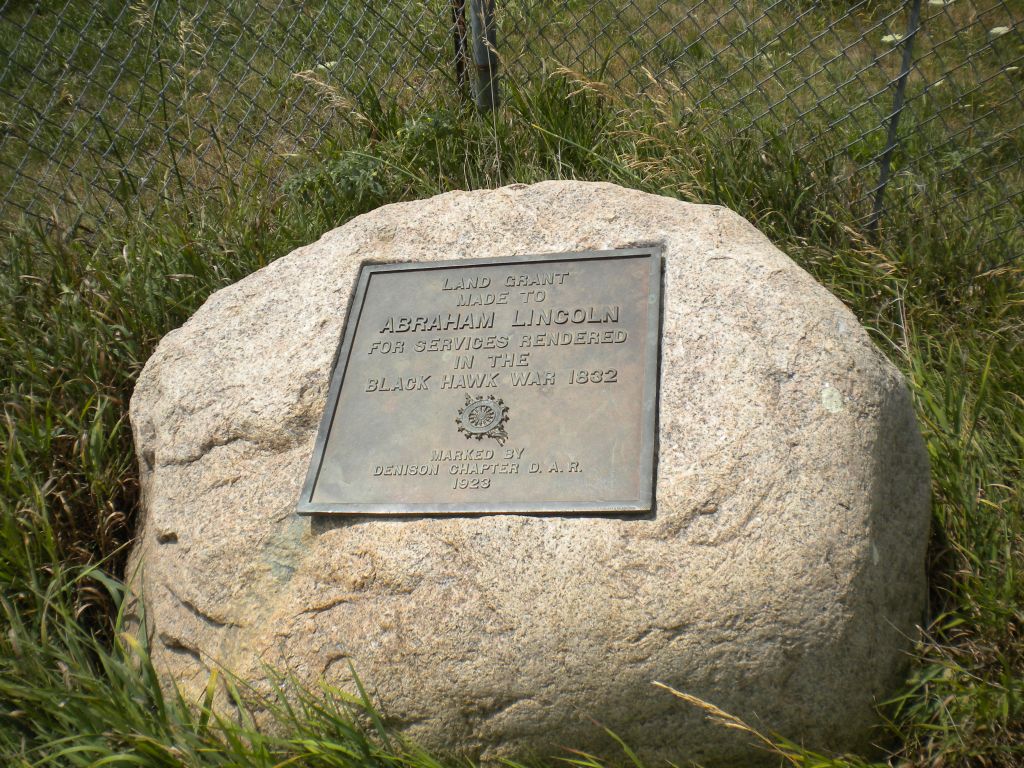
Rewarding military veterans with land is a custom going back to ancient times, and such a popular law was easy to pass in the U.S. Congress in the first half of the nineteenth century, as the United States expanded rapidly in territory. Congress had compensated veterans of the Revolutionary War, the War of 1812, and the Mexican-American War with land grants, and in 1850, it passed a law doing the same for veterans of any Indian war after 1790. Lincoln received a warrant good for forty acres. He eventually engaged Dubuque attorney John P. Davies to use it to acquire a parcel in Tama County. His title was perfected in 1855, for the following described land: “The Northwest quarter of the Southwest quarter of Section 20 in Township 84 North, Range 15 West.”
In the same year, Congress gave veterans more land. Lincoln was eligible for 160 acres, less any amount already bestowed. Once again, he did not act immediately. Was he waiting to find a juicy plot, hoping to make his fortune on speculation? Not according to a story told by a couple of Iowans.
W.H.M. Pusey was an old friend of Lincoln’s from Springfield who moved to Council Bluffs. He and D.C. Bloomer reminisced about Lincoln’s 1859 visit to their city about forty years after the fact. They recalled him pulling out his warrant, still unused, during a conversation about the old days. They chided him for not turning it to his advantage. He said that he brought it along thinking he might find some land in Kansas or Iowa, but that he had previously just thought he would someday give it to his sons, “that they would always be reminded that their father was a soldier!” There were some glaring inaccuracies in their story, but there is a ring of truth about it.
Ultimately, he took title to his 120 acres in Crawford County. Acting as his own attorney, he got possession in 1860, shortly before his election to the presidency, of the following described parcel: “The East half of the North East quarter and Northwest quarter of the North East quarter of Section Eighteen in Township Eighty four North of Range Thirty nine west.”
One of Lincoln’s purposes for visiting Council Bluffs was to inspect some land locally. His friend, Norman B. Judd, was a railroad attorney who borrowed $2,500 from Lincoln in 1857, at 10% interest per year, to purchase land in Council Bluffs, believing the area was destined for a major railroad. Now Judd wanted to renew and increase the loan, and offered seventeen city lots in Council Bluffs and ten acres along the anticipated route of the Mississippi and Missouri Railroad as collateral. After his trip, Lincoln accepted the terms, and the land was quitclaimed to him.
Lincoln the Land Baron never made it big. After he became president, he knew he might be criticized for starting the western railroad at the town where he owned land, but he did it anyway because it made the most sense. However, he realized nothing from the venture – the property reverted to Judd when the loan was repaid after Lincoln’s death.
Lincoln died without seeing the farmland he acquired in Tama and Crawford Counties. In 1874, his widow, Mary Todd Lincoln, sold the Tama County land to their son Robert for $100. Robert and his wife Mary Harlan Lincoln sold the farm to Adam Brecht of Tama County in 1875 for $500.
After Mary Todd Lincoln’s death in 1882, Robert was the sole surviving heir of his parents, his three brothers all having died before reaching full adulthood. He and his wife sold the Crawford County parcel in 1892 while living in London, where Robert was serving as American minister to Great Britain. Henry Edwards of Crawford County bought the land for $1,300.
There’s a postscript that ties the whole story together: The Fox Indians are also known as the Meskwaki. They were exiled to Kansas after the Black Hawk War, though some never left. In 1857 the Iowa legislature, in unprecedented fashion, allowed some of them to buy land so they could live in Iowa. They purchased land in Tama County, just a few miles from Lincoln’s land, and the tribe lives there to this day.
Below: Markers in Tama and Crawford Counties


 Mostly Lincoln